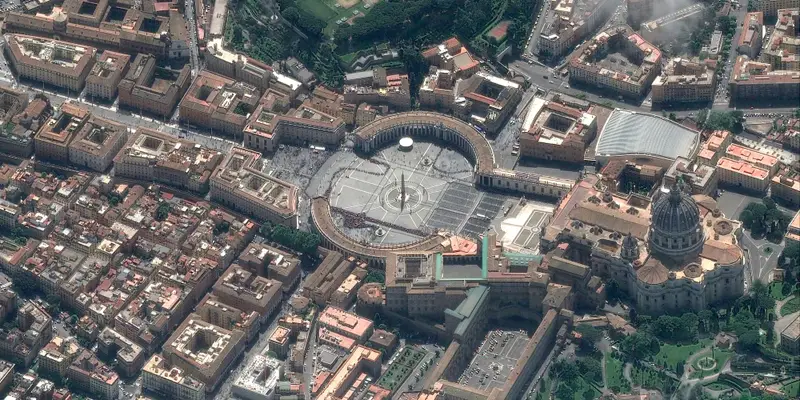
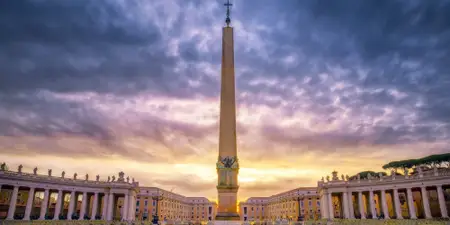
Bernini's St. Peter's Square, built through the 1660s, was deliberately designed as an ellipse — not a circle or rectangle — so its colonnade could, in his own words, embrace visitors "like the maternal arms of the Church."
ShapeAn ellipse, plus a trapezoidal forecourt closer to the basilica
Colonnade statues140 saints, atop the curving colonnades
Nothing about the square's shape is accidental.
An ellipse, on purpose
Bernini chose an oval rather than a circle or rectangle specifically so the colonnades could curve outward — welcoming pilgrims in rather than simply framing a view.
A gathering space built for crowds
The square can hold roughly 300,000 people, and still fills for events like the Easter Urbi et Orbi blessing.
Why did Bernini choose an ellipse instead of a circle for St. Peter's Square?
An ellipse let him fit a much larger, more welcoming open space into the awkward site in front of the Basilica than a true circle would have allowed.
How many columns make up Bernini's colonnade?
284 columns arranged in four rows, positioned so that from two specific marked spots in the square, all four rows appear to align into one.
Is the obelisk in the square older than the square itself?
Considerably — the obelisk predates the square by over 1,500 years and was only moved to its current position in 1586, decades before Bernini began his design.