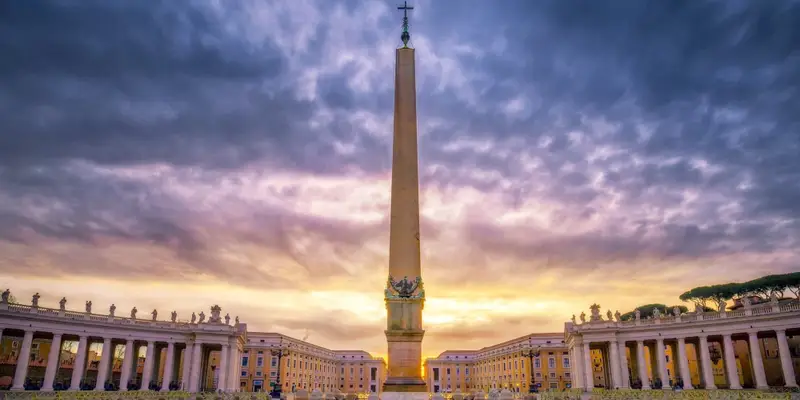
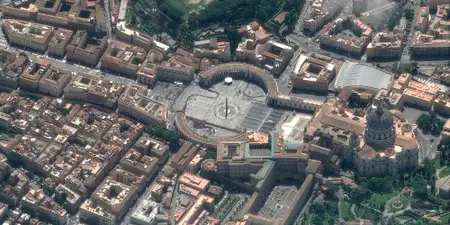
The 25-metre red granite obelisk in St. Peter's Square is a genuine ancient Egyptian monument, brought to Rome by Caligula in AD 37 and moved to its current spot in a famous 1586 engineering operation — and, according to a popular medieval belief now disproven, once thought to contain the ashes of Julius Caesar.
Moved to St. Peter's SquareFACT — 1586, under Sixtus V
Contains Caesar's ashesMYTH — debunked, see below
Rome has plenty of obelisks. Only one has never fallen since Roman times.
FACT — an Egyptian monument in a Roman circus
Caligula had it shipped from Heliopolis to decorate the spina of his private circus in AD 37 — a stadium later used by Nero, on the same ground where tradition holds Saint Peter was martyred.
FACT — the 1586 move: a 300-ton gamble
Engineer Domenico Fontana moved the obelisk to its current position using hundreds of men, horses and winches. Spectators were ordered to stay silent on pain of death — until, tradition holds, a sailor named Bresca shouted "Acqua alle funi!" ("Water the ropes!") as friction set them smoking, saving the operation. His hometown was reportedly rewarded with the privilege of supplying the Vatican's Palm Sunday fronds ever since.
MYTH — the ashes of Julius Caesar
A medieval belief held that the bronze globe once mounted on top held Caesar's ashes. When it was finally opened, it was found empty. The globe is now on display in Rome's Capitoline Museums; a cross with a relic of the True Cross sits atop the obelisk today instead.
Does the obelisk really contain Julius Caesar's ashes?
No — this is a debunked medieval myth. The bronze globe once on top was opened and found empty; it's now in the Capitoline Museums.
Did the obelisk really witness Saint Peter's martyrdom?
Uncertain, but plausible: it stood at the edge of the circus traditionally identified as the site of Peter's execution, though this can't be independently verified.
How was the obelisk actually moved without modern machinery?
With an enormous system of ropes, pulleys and hundreds of men and horses, in a famously risky 1586 operation overseen by architect Domenico Fontana — one miscalculation could have brought it crashing down.