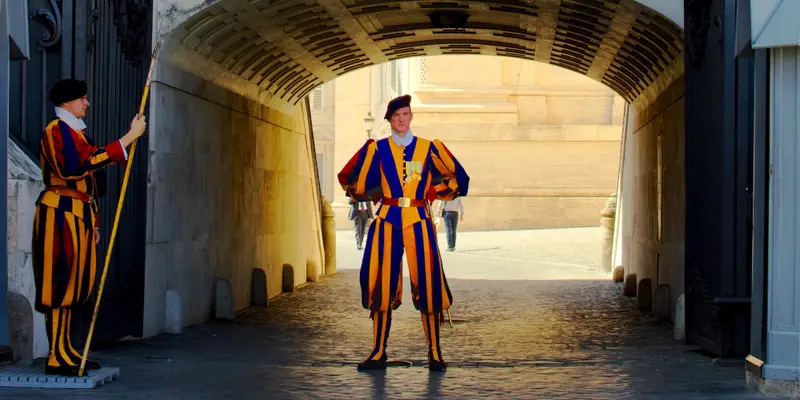
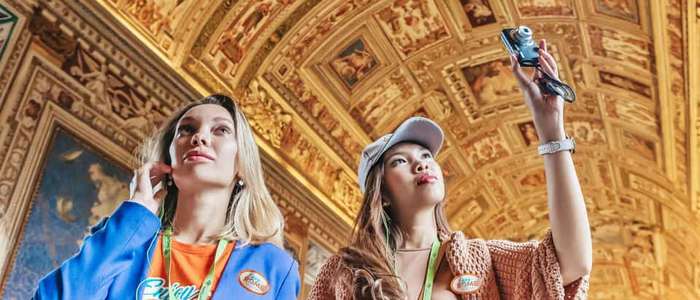
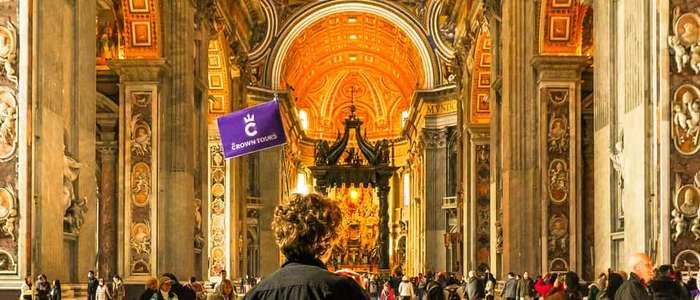
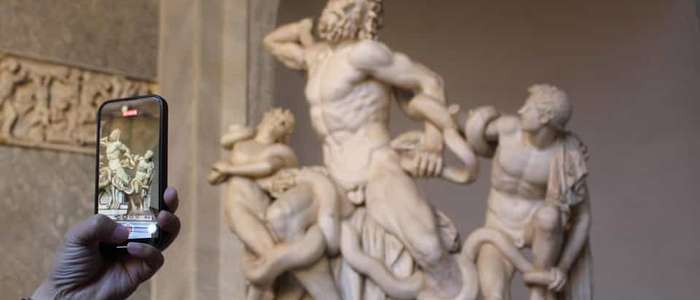
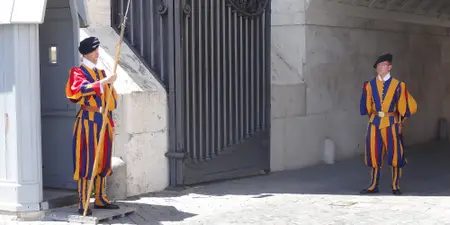
Founded in 1506 by Julius II, the Swiss Guard is among the world's oldest continuously operating military units — best known for the 1527 "Sack of Rome," when 147 of 189 guards died defending Pope Clement VII, an event still marked every May 6 when new recruits are sworn in; their colourful uniform, despite a persistent myth, was not designed by Michelangelo.
Famous last standFACT — Sack of Rome, 1527, 147 of 189 killed
New recruits sworn inFACT — every May 6, anniversary of 1527
Uniform designed by MichelangeloMYTH — actually redesigned in 1914
The world's smallest army has one of its most eventful histories.
FACT — founded to protect a Renaissance pope
Julius II recruited Swiss mercenaries in 1506, drawing on their contemporary reputation as Europe's most disciplined soldiers.
FACT — the Sack of Rome, 1527: a last stand
When mutinous imperial troops sacked Rome, most of the Guard died holding the steps of St. Peter's so Clement VII could escape along the fortified Passetto di Borgo to Castel Sant'Angelo. New guards are still sworn in every May 6 in their memory.
MYTH — the uniform
Despite the popular story, no evidence connects the current uniform to Michelangelo. It was substantially redesigned in 1914 by Commander Jules Repond, drawing loosely on Renaissance-era paintings for inspiration.
Did Michelangelo design the Swiss Guard's uniform?
No — this is a widely repeated but unsupported myth. The current design dates to a 1914 redesign, not a documented Renaissance original.
Why specifically Swiss guards?
Swiss mercenaries had an outstanding reputation for discipline and loyalty across 15th–16th century Europe. Recruits today must still be Swiss, Catholic, unmarried, and have completed Swiss military training.
Do Swiss Guards actually use their halberds, or are they purely ceremonial?
Mostly ceremonial today, though guards do train in their traditional use — modern security at the Vatican relies on plainclothes and armed personnel working alongside them.