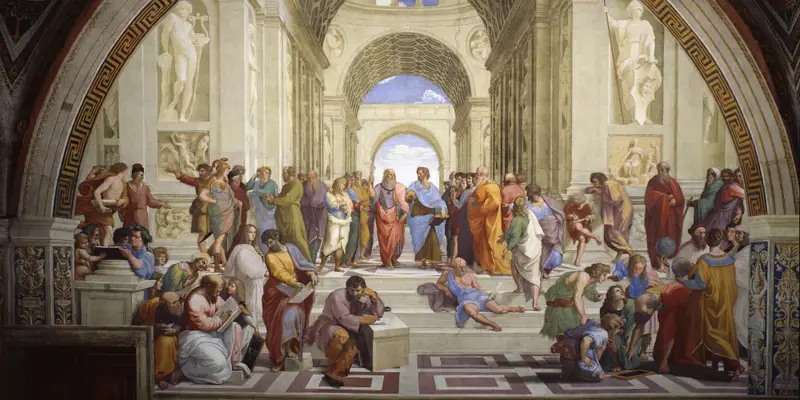
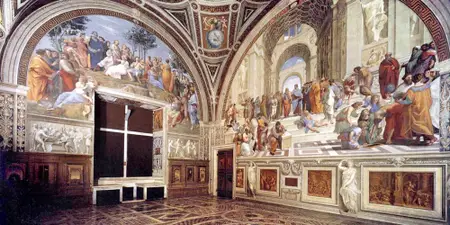
The Raphael Rooms are four rooms in the Vatican Museums that Raphael and his workshop frescoed for Pope Julius II starting in 1508, including the School of Athens — a gathering of ancient philosophers considered one of the defining works of the High Renaissance.
Raphael was in his mid-twenties, relatively unproven, when Julius II commissioned him to redecorate his
private apartments — the result became one of the defining fresco cycles of the Renaissance.
The four rooms
The Stanza della Segnatura came first and includes the School of Athens; the
Stanza di Eliodoro and Stanza dell'Incendio followed. The final room, the
Sala di Costantino, was largely completed by Raphael's workshop after his death in 1520.
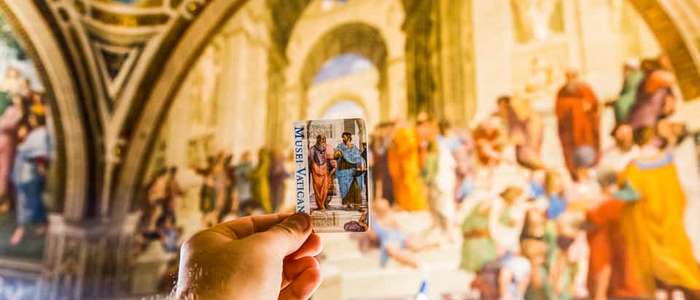
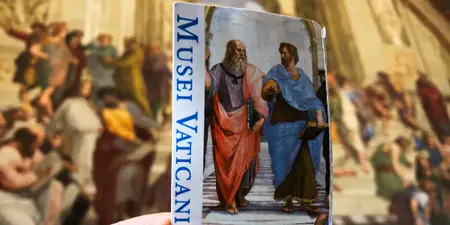
The School of Athens
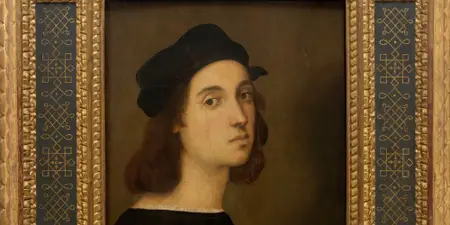
An idealised gathering of ancient philosophers, with Plato and Aristotle at the centre — Raphael is
widely believed to have included a self-portrait among the figures at the edge of the scene.
No — he personally painted much of the first two rooms, but the later rooms were largely completed by his workshop after his death in 1520.
What is the School of Athens?
A fresco in the Stanza della Segnatura showing an idealised gathering of ancient Greek philosophers, with Plato and Aristotle at its centre.
Are the Raphael Rooms usually as crowded as the Sistine Chapel?
Slightly less, though they still get busy since they're on the direct route to it — the last room before the Chapel tends to be the most congested of the four.