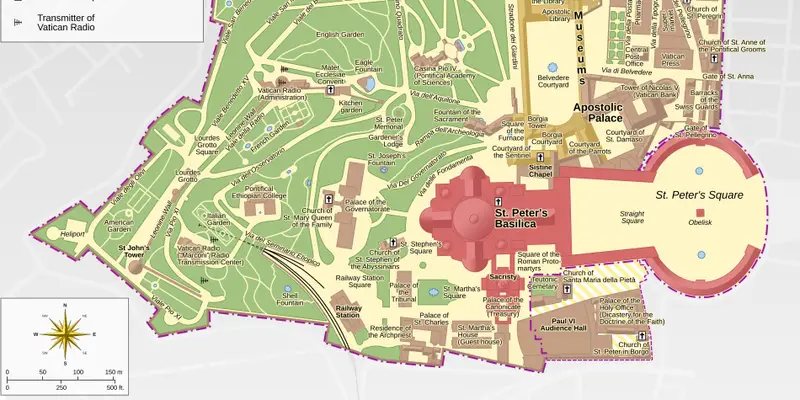
Depending on context, “the Vatican” can mean Vatican City (the world's smallest sovereign state, at 0.44 km²), the Holy See (the Catholic Church's central government), or simply the pope's residence and offices — most visitors mean the first.
It's one word doing the work of three different ideas.
Three meanings, one word
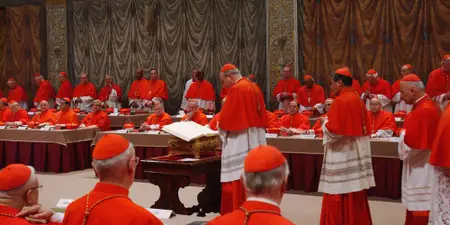
“Vatican” is used for the physical territory, the Church's governing authority based there, and — loosely — the pope's administration in general.
Vatican City: a country you can walk across in an hour
As a sovereign state, Vatican City is smaller than most public parks, with its own postal system, license plates, and a resident population of under a thousand.
Why it's separate from Italy
It became fully independent in 1929, specifically so the Church's leadership could operate without being subject to any national government, including Italy's.
No — it's an independent country, entirely surrounded by the city of Rome but not administratively part of it or of Italy.
Is "the Vatican" the same thing as "the Catholic Church"?
Not exactly — the Vatican is the physical and administrative centre, but the Catholic Church as an institution extends far beyond its walls to dioceses worldwide.
Who actually lives in Vatican City?
Around 800 people, mostly clergy, Swiss Guards and some lay staff — making it the least populous sovereign state in the world.